A2P 10DLC registration for small business (plain-English guide)
Answer first: US carriers require A2P 10DLC registration before business SMS on a local number delivers reliably. Register your brand and campaign with accurate use-case samples — or reminders, review requests, and missed-call texts stop landing after testing.
Why your business texts stopped delivering
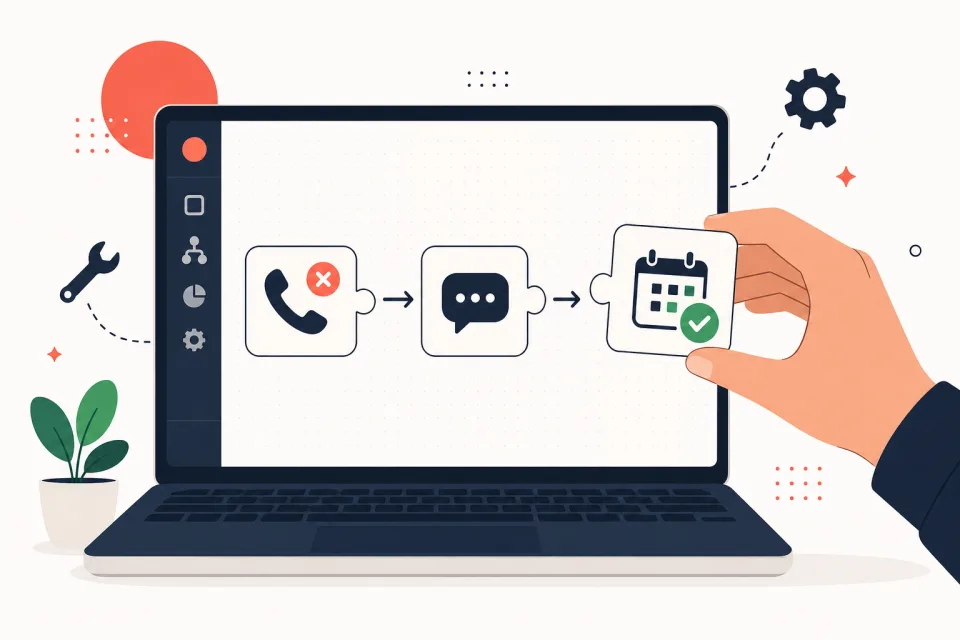
The pattern is always the same: you wire up missed-call text-back, appointment reminders, or review requests, send a test to your own phone — it works — then real customers stop getting messages a week later. Nothing changed in your workflow; carriers started filtering an unregistered number.
Since 2023, US mobile carriers (AT&T, T-Mobile, Verizon and their MVNOs) require businesses sending SMS from local 10-digit numbers to register who they are (the brand) and what they send (the campaign) through the A2P 10DLC system. Unregistered traffic gets lower throughput, silent drops, or hard blocks — especially once volume climbs past a handful of messages per day.
What A2P 10DLC is (plain English)
A2P = Application-to-Person (your software texting a person). 10DLC = a standard local phone number (not a short code). Registration has two layers:
- Brand registration — your legal business (EIN, address, website) verified against public records. One brand per EIN in most setups.
- Campaign registration — the specific use case: appointment reminders, customer care, marketing, etc., plus 2–5 sample messages and opt-out language.
Carriers match every outbound text to an approved campaign. Send something that does not match your declared use case and delivery suffers — even if the brand is approved.
Register A2P 10DLC in GoHighLevel (step-by-step)
We walk through GoHighLevel because it is where we run speed-to-lead, text-back, reminders, and review loops on one $97/month plan — but the brand/campaign concepts are the same on any SMS platform.
- Open compliance settings. Sub-account → Settings → Phone Numbers → Trust Center / A2P 10DLC (wording varies slightly by account age).
- Register your brand. Legal business name exactly as on your EIN letter, EIN, business type (sole prop, LLC, etc.), address, website URL, and contact email. Sole proprietors without an EIN can sometimes use a different verification path — follow the in-app prompts.
- Wait for brand approval. Usually one to three business days. Mismatched names are the top rejection — "Joe's Plumbing LLC" on the form vs "Joe Smith Plumbing" on IRS records.
- Create a campaign. Pick the closest use case (Customer Care, Account Notification, Marketing, etc.). Write a plain description: "Appointment reminders and scheduling updates for existing customers who booked online or by phone."
- Add sample messages. Paste real messages you will send, each ending with opt-out: "Reply STOP to unsubscribe." Example: "Hi [name], reminder: your appointment with [business] is tomorrow at [time]. Reply STOP to opt out."
- Link your phone number(s). Assign the local number(s) that send SMS to the approved campaign before turning workflows live.
- Test on a real handset. Send from the production number to a colleague's phone on a different carrier. If it lands, enable your workflows.
Common rejection reasons and fixes
- EIN / legal name mismatch — copy from your IRS CP 575 or state registration; no DBA abbreviations unless filed.
- Vague campaign description — "SMS marketing" fails; "Post-service review requests and appointment reminders for customers who completed a job" passes.
- Missing opt-out in samples — every sample message needs STOP language; carriers treat this as non-negotiable.
- Wrong use case — marketing campaign for purely transactional reminders gets flagged; pick Account Notification or Customer Care when appropriate.
- Website does not match brand — the URL you submit should show the business name and a privacy policy; bare landing pages slow approval.
Rejections include a reason code in the platform inbox. Fix only what they cite, resubmit, and budget another one to five business days — do not spin up a second brand to "start over"; that creates duplicate EIN problems.
What registration costs and how long it takes
Pricing checked July 2026 on GoHighLevel's LC Phone / Lead Connector flow.
- Brand registration: roughly $4–$15 one-time (provider-dependent).
- Campaign registration: roughly $10–$15 one-time per campaign; most small businesses need one campaign covering reminders + review requests if samples match.
- Per-message usage: ~$0.0083 per SMS segment on GHL after approval — unchanged by 10DLC except you actually deliver.
- Timeline: plan seven calendar days from first submit to production-safe SMS; same-day approval happens but is not something to schedule around.
When you can skip SMS (for now)
Skip 10DLC registration if you are not texting US mobile numbers — email-only follow-up, WhatsApp where customers opt in, or phone-only outreach. International SMS rules differ; Canada has its own registration path on some providers.
Also skip building SMS automations entirely if you get under ~10 customer touches a month — a personal call may beat the compliance overhead. If you are investing in SMS clusters, register once and reuse the same approved campaign across text-back, reminders, and review requests.
Common questions
What is A2P 10DLC and why does my business need it?
A2P 10DLC is the US carrier system for Application-to-Person business texting on local 10-digit numbers. Carriers require brand and campaign registration before they deliver marketing and operational SMS reliably. Without it, texts often work in sandbox testing then get filtered or blocked in production.
How long does A2P 10DLC registration take?
Brand registration usually completes in one to three business days once your EIN and business details match public records. Campaign approval often takes another one to five business days if your use-case description and sample messages are clear. Rejections add a resubmit cycle — budget a full week before go-live.
How much does A2P 10DLC registration cost?
Through GoHighLevel and most SMS providers, brand registration is typically around $4–$15 one-time and each campaign around $10–$15 one-time, plus your normal SMS usage (~$0.0083 per segment on GHL). There is no monthly 10DLC subscription — it is registration fees plus per-message usage.
Why was my A2P campaign rejected?
Common reasons: EIN or legal name mismatch, vague campaign description ("marketing"), sample messages missing opt-out language ("Reply STOP to opt out"), or a use case that does not match what you actually send. Fix the fields, resubmit, and wait another review cycle.
Can I text customers without A2P 10DLC?
In the US, not reliably on a local business number. Email-only outreach, purely transactional OTP on dedicated short codes, or not texting US numbers at all are the alternatives. If you run reminders, review requests, or missed-call text-back to US mobiles, plan on 10DLC registration.
Get compliant before you flip the switch
Do it yourself: start a GoHighLevel 14-day trial, submit brand + campaign on day one, build your workflows while approval runs, then test on real handsets before going live.
Have us do it: A2P registration is the #1 blocker on DIY setups — we file brand and campaign, link numbers, and test delivery as part of every done-for-you GoHighLevel setup.
Get the GHL Setup Checklist — free
The exact checklist we run for paying setup clients: 27 steps from empty account to booked appointments, including the A2P compliance items everyone forgets. Drop your email and read it right away.
No spam, no sequence-of-doom. We only email when we publish something worth your time. Privacy policy.