Contractor missed calls: the jobs you're losing on the ladder
Answer first: when you're on a roof, under a sink, or driving between estimates, every unanswered ring is a homeowner dialing your competitor next. Contractors routinely lose $3,000–$4,000 a month this way — not from bad work, but from bad phone coverage. Missed call text-back answers in seconds for under $2/month in SMS; below is the math, why voicemail fails, and what your first week of setup actually looks like.
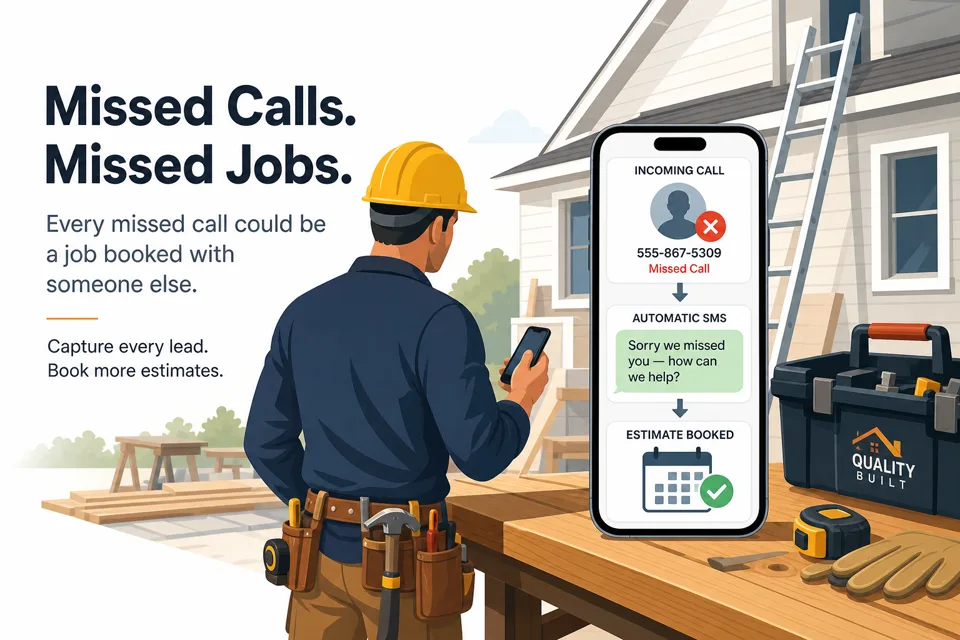
You're not losing jobs to bad work — you're losing them to missed rings
Homeowners call when something breaks or when they're ready to buy — burst pipe, dead AC, roof leak after a storm, kitchen remodel quote. That is the highest-intent lead in your business. And the moment it rings out, they open Google Maps and tap the next contractor.
Reddit threads and trade Facebook groups repeat the same story: two or three missed calls a month can mean losing a $5k deck, a $25k roof, or a $400 emergency service call that would have been yours. Surveys in the home-services space put the annual bleed at $75,000–$100,000 for businesses that miss even a fraction of inbound calls — and roughly 62% of missed-call leads never come back once they hit voicemail or silence.
This is not a marketing problem. It is a coverage problem — and it gets worse the better your Google ranking is, because more calls arrive while you're physically unable to answer.
The contractor math (use your own numbers)
Plug in what you actually see:
- Missed calls per week — check your carrier log or forward a tracking number through GoHighLevel for a honest count. Most owner-operators are surprised: 8–15 is common once you measure.
- Average job value — HVAC service call $250–$450; plumber $300–$600; roofing or remodel inquiry $5,000–$25,000. One saved emergency call often pays for a year of automation.
- Close rate on answered calls — if you close 30% of estimates you actually run, every missed ring is 30% of that ticket walking to someone who picked up.
Our missed-call calculator runs this with your call volume and ticket size. Competitor articles throw around $3,800/month — that is plausible for a shop missing ten calls a week at a $400 average; your number may be higher or lower, but it is rarely zero.
Why voicemail and "I'll call them back" do not save you
Voicemail feels like coverage. It is not. Most callers under 50 will not leave one — they wanted you now, not a callback tag at 6pm. Saturday morning and after-hours inquiries are peak times for homeowners; that is exactly when you are off the clock or on another job.
Calling back three hours later often reaches voicemail on their end. By then they have already booked your competitor, the one whose phone sent a text in 30 seconds saying "sorry we missed you — want to grab a time?"
Live answering services fix the human gap — but at $200–$400/month and they still miss nuance on trade-specific questions. Text-back covers the 80% case: acknowledge the caller instantly, offer a booking link, and pull the conversation into your inbox when you step off the ladder.
The fix: missed call text-back (contractor edition)
Missed call text-back is one automation: when a call is not answered, an SMS fires within seconds. The caller gets a response while they are still holding the phone. You look like the business that answered, even when you did not.
We run this on GoHighLevel because the phone trigger, SMS, unified inbox, and estimate booking calendar are one platform on the $97 plan — no gluing a texting app to a separate scheduler. The full step-by-step build (number setup, workflow, reply routing) is in our missed call text-back guide; here is the contractor-specific version of what matters:
- Forward your main line or buy a local tracking number. Homeowners call the same number on your truck wrap and Google listing. Forward it to your cell, or port the number into GHL. Test a live call before you build anything else.
- Start A2P 10DLC registration immediately. US carriers require business texting registration — see our A2P 10DLC guide. Unregistered numbers get texts silently filtered; that is why "it worked in testing" setups die in week two. Approval takes a few business days — start on day one.
- Workflow trigger: call status "missed." Action: send SMS. Message template: "Sorry we missed you! This is [company]. How can we help — or grab a time here? [booking link]." Short, named, one question, one link.
- Route replies to your phone. GHL inbox + mobile app push notifications. Add an auto-offer of your estimate calendar so homeowners self-book while you are on site.
- Quiet hours and STOP. No texts at 2am; honor opt-outs automatically. Both are checkboxes; both matter legally.
What week one actually looks like
Competitor pages sell the dream; here is the honest timeline from setups we have run on live accounts:
- Day 1: Number forwarded or ported, A2P brand + campaign submitted, test call confirms missed status fires in the CRM.
- Days 2–4: Waiting on carrier approval. Draft your SMS copy and booking link; do not turn the workflow on until A2P clears.
- Day 5–7: Workflow live, push notifications on, team knows replies land in the inbox. First real missed call gets a text — verify delivery on a colleague's phone.
- Week 2 onward: First saved job typically shows up here — a homeowner who texted back "need AC looked at tomorrow" while you were on another install. One job covers months of platform cost.
Realistic win-back across contractor accounts: 10–30% of missed callers re-engage — highest for appointment-based trades (HVAC, plumbing, electrical) where booking a slot is the natural next step.
What it costs (real pricing, not "contact us")
On GoHighLevel, missed call text-back is included in the $97/month Starter plan. Usage adds about $0.0083 per SMS segment plus ~$1.15/month for the tracking number.
A contractor missing 40 calls a month spends well under $2 on texts. Standalone missed-call-text-back SaaS sells the same behavior for $99–$299/month. Live answering runs $200–$400/month and still cannot book your calendar directly. Full plan context is in our GoHighLevel review; the solution page walks through fit and pricing before you build.
When text-back is not the right move
Skip it if:
- Your office already answers every call. Text-back is your after-hours and overflow net, not a replacement for a receptionist you already pay for.
- Your phone rarely rings. Under five inbound calls a week — fix your Google Business Profile and reviews first.
- Leads come by form, not phone. Commercial GCs and B2B subs often get RFPs by email; fix speed-to-lead on forms instead.
- Your customers genuinely prefer voicemail. Rare in residential home services, but measure before you assume.
Same honesty as our reviews: text-back fixes the phone leak; it does not replace showing up on Google, collecting reviews, or running tight estimates. It stops the bleeding while you work on the rest.
Contractor missed-call FAQ
How much revenue do contractors lose from missed calls?
Industry surveys and contractor forums put the range at $3,000–$4,000 per month for a typical home-services business missing a handful of calls weekly — and $75,000–$100,000 per year at higher call volume. One missed emergency plumbing or HVAC call can be $300–$500; a roofing or remodel inquiry can be $5,000–$25,000. The exact number depends on your average ticket and close rate — use a missed-call calculator with your own call log before you assume it is small.
Why do contractors miss so many calls?
You are on a roof, under a house, on a noisy job site, or driving between estimates when the phone rings. Crews cannot pause safely to answer. After hours and Saturdays are peak inquiry times for homeowners. The pattern is not neglect — it is physics. The fix is a system that responds when you physically cannot.
Does voicemail work for contractor leads?
Poorly. Most homeowners under 50 will not leave one; they tap the next business on Google Maps. Research cited by answering-service vendors puts roughly 62% of missed-call leads as permanently lost once they reach voicemail or no answer. Speed wins in home services — the contractor who texts back in 30 seconds beats the one who calls back at 5pm.
What is missed call text-back for contractors?
An automation that sends an SMS within seconds when you miss a call: "Sorry we missed you — this is [company]. How can we help, or grab a time here? [link]." The caller gets a response while they are still holding the phone, and replies land in a unified inbox or booking calendar. On GoHighLevel it is a single workflow triggered by call status "missed."
How much does missed call text-back cost for a contractor?
On GoHighLevel the automation is included in the $97/month Starter plan. Usage adds about $0.0083 per SMS segment plus roughly $1.15/month per tracking number. A contractor missing 30–50 calls a month typically spends under $2 on texts. Standalone missed-call services charge $99–$299/month; live answering services run $200–$400/month for comparable coverage.
Do I need A2P 10DLC registration for contractor text-back?
Yes, for business SMS to US mobile numbers. Carriers require A2P 10DLC brand and campaign registration before texts deliver reliably in production. Unregistered numbers often work in testing then get filtered — the most common reason DIY text-back setups fail in week two. Approval takes a few business days; start registration on day one of setup.
Stop losing jobs on the ladder this week
Not sure the math applies to your call volume? Start with the solution page — lost-revenue calculator, fit check, and pricing before you build.
Do it yourself: start a GoHighLevel 14-day trial and follow the build in our missed call text-back guide — register A2P on day one so approval lands inside your trial.
Have us do it: tracking number, A2P registration, workflow, reply routing, and booking link tested with real calls — part of our done-for-you GoHighLevel setup, or standalone if text-back is all you need right now.
Get the GHL Setup Checklist — free
The exact checklist we run for paying setup clients: 27 steps from empty account to booked appointments, including the A2P compliance items everyone forgets. Drop your email and read it right away.
No spam, no sequence-of-doom. We only email when we publish something worth your time. Privacy policy.